Unlocking the Source of Life in the Air: Exploring the Atmospheric Water Generator
Jan 30, 2026
In today's world, the increasing scarcity of freshwater resources has become a global challenge. With population growth, climate change, and intensifying pollution, finding sustainable water solutions has become more important than ever. Against this backdrop, an innovative technology—the commercial atmospheric water generator (AGG)—is gaining increasing attention, capable of extracting drinking water from the air we breathe.
How the Atmospheric Water Generator Works
The core principle of the Drinking Water Solutions is to mimic the formation process of dew and rainwater in nature. It captures moisture from the air through several key steps:
Air Suction: First, a built-in fan draws surrounding air into the machine.
Air Filtration: The intake air passes through a multi-layer filtration system to remove dust, pollen, microorganisms, and other contaminants, ensuring that the resulting water is clean.
Cooling and Condensation: The filtered air is directed to a cooling coil or evaporator. When the warm, moist air comes into contact with this surface, which is much cooler than the dew point, the water vapor in the air condenses into liquid water droplets. This is similar to the principle behind water droplets forming on the walls of a cold beverage glass in summer.
Collection and Purification: The condensed water droplets are collected in a storage tank. Before entering or leaving the tank, this water typically undergoes further purification, including activated carbon filtration, ultraviolet (UV) sterilization, and mineral rebalancing (to improve taste and health benefits) to ensure drinking water quality.
Circulation and Dehumidification: The dried air is expelled from the machine, and the entire process is continuously circulated, constantly extracting moisture from the air.
Advantages of Atmospheric water generator for irrigation
Independent Drinking Water Source: The biggest advantage is its ability to provide independent drinking water without the need for an external water source. This is revolutionary for remote areas, arid regions, disaster areas, or areas with poor water quality.
High-Quality Drinking Water: Due to multiple filtration and sterilization processes, air-to-water generators typically produce high-quality, pure drinking water, even superior to some tap water.
Environmentally Friendly: It does not involve extracting groundwater or relying on complex water supply networks, resulting in a relatively small environmental impact.
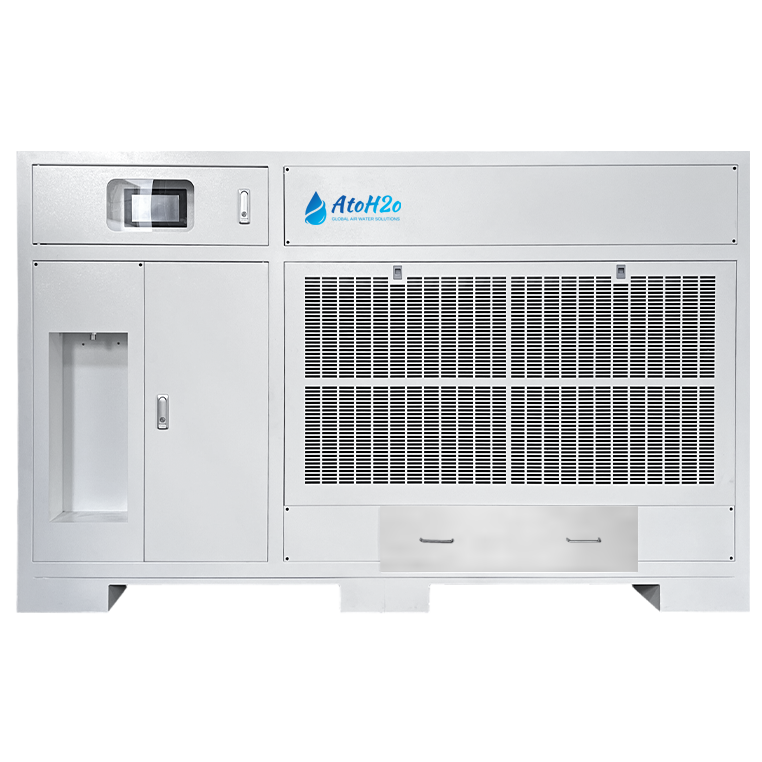
Portability and Flexibility: Many air-to-water generators are compact and easy to move, making them suitable for use in various settings such as homes, offices, RVs, and even military bases.
Emergency Water Supply: Air-to-water generators can serve as an important emergency water supply solution when traditional water supply systems are disrupted by natural disasters.
Challenges and Considerations
Despite the promising future of air-to-water generators, several challenges exist:
Performance is Affected by the Environment: Water production and efficiency are highly dependent on ambient temperature and relative humidity. High temperature and humidity significantly increase water production, while efficiency drops drastically in cold, dry environments.
Energy Consumption: Cooling and dehumidification processes consume electricity, especially in low humidity environments, potentially leading to higher water production costs. This drives manufacturers to continuously develop more energy-efficient technologies.
Initial Cost: The initial purchase cost of air-to-water generators is typically higher than traditional methods of obtaining drinking water.
Maintenance: Regular filter replacements and tank cleaning are necessary to ensure water quality and machine efficiency.
With technological advancements, the efficiency of air-to-water generators is continuously improving, energy consumption is gradually decreasing, and versions incorporating renewable energy sources such as solar power are emerging, further enhancing their sustainability. In the future, as water scarcity intensifies, air-to-water generators are expected to play a greater role in the following areas:
Household and Commercial Applications: Becoming a new alternative to bottled water and traditional water dispensers.
Humanitarian Aid: Providing reliable drinking water in water-scarce areas.
Industry and Agriculture: Providing ultrapure water for specific production processes or irrigation water in small-scale agriculture.






 Network Supported