Atmospheric Water Generator: Transforming Air into a Sustainable Source of Fresh Water
Nov 07, 2025
Water scarcity is one of the most pressing global challenges of the 21st century. According to the United Nations, more than two billion people live in areas experiencing severe water stress, and the number continues to grow as climate change reshapes weather patterns and depletes natural freshwater reserves.
In this context, residential atmospheric water generator (AWG) have emerged as an innovative technology capable of harvesting water directly from air humidity, offering a decentralized, renewable, and potentially limitless water source.
1. What Is an Atmospheric Water Generator?
An atmospheric water generator manufacturers (AWG) is a device that extracts water from ambient air by cooling it below its dew point or by using desiccant-based condensation. The system then purifies and mineralizes the condensed water, producing drinkable, high-quality freshwater.
In its simplest form, an AWG operates like an Atoh2o“air-to-water” generator—it pulls in humid air, condenses the moisture, and stores the clean water for use. However, industrial and modern AWG systems incorporate advanced energy management, sterilization, and water quality control to ensure sustainable and hygienic operation.
2. Working Principle and Core Technologies
There are two primary AWG technologies in use today: Cooling Condensation Systems and Desiccant-Based Systems.
a. Cooling Condensation AWG
This method operates on the same principle as an air conditioner:
Humid air is drawn into the system through fans and air filters.
The air passes over cooled coils maintained below the dew point temperature.
Moisture from the air condenses on the coils, forming water droplets.
Collected water is filtered, UV-sterilized, and mineralized for taste and safety.
These systems are highly efficient in humid climates where relative humidity exceeds 40%.
b. Desiccant-Based AWG
This method uses hygroscopic materials (such as silica gel, lithium chloride, or organic desiccants) to absorb moisture from the air.
The absorbed water is then released through heating and condensed into liquid form.
Desiccant systems are particularly suitable for dry or arid regions, since they can operate effectively even at low humidity levels where cooling systems fail.
3. Components and System Design
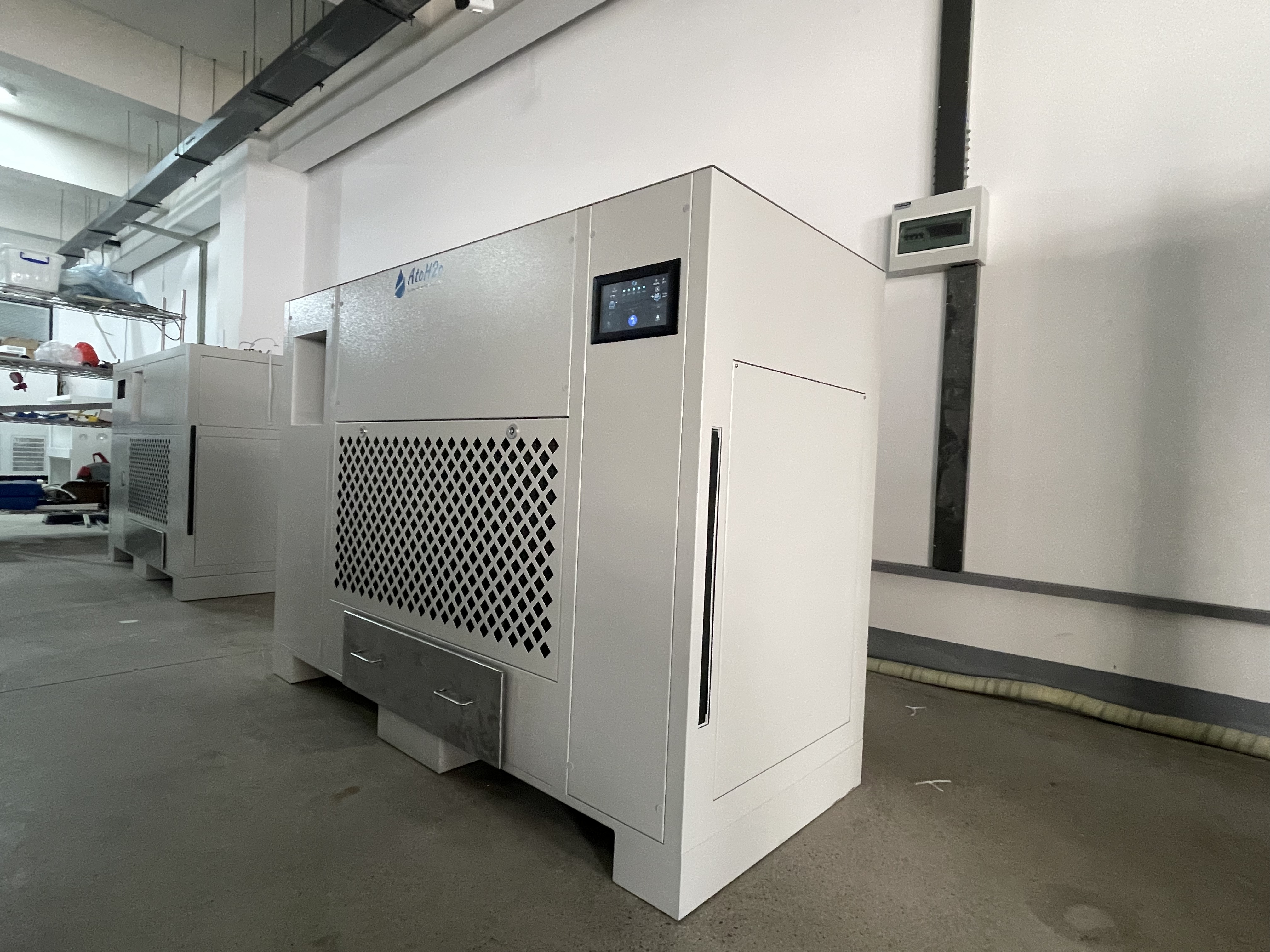
A standard AWG typically includes:
Air Intake Unit: Draws air through dust and particle filters.
Cooling / Adsorption Chamber: Regulates air temperature or captures humidity via desiccants.
Condensation Surface: Collects water droplets as the air cools.
Filtration and Purification: Multi-stage filtering, UV sterilization, and carbon filtration ensure the water meets drinking standards.
Mineralization Unit: Adds essential minerals such as calcium and magnesium for balanced drinking water.
Storage and Dispensation: Safe water reservoir with anti-bacterial lining and delivery tap system.
Many advanced models also feature IoT-based monitoring for temperature, humidity, and water output, optimizing performance automatically according to environmental conditions.
4. Energy Consumption and Sustainability
Energy efficiency is a key concern for AWG technology. Conventional systems consume between 0.3 – 0.8 kWh per liter of water produced, depending on humidity levels.
To improve sustainability, modern AWGs often integrate:
Solar photovoltaic systems to power the compressor and fan units.
Heat recovery mechanisms that reuse waste heat to preheat incoming air.
Smart energy management software to optimize runtime during peak humidity hours.
The combination of renewable energy and intelligent operation transforms AWGs into self-sufficient water generation units, reducing carbon emissions and operational costs.
5. Applications and Industry Use Cases
a. Domestic and Office Use
Small-scale AWGs serve as point-of-use systems for homes, offices, and schools, providing safe drinking water without reliance on bottled or piped supplies.
b. Military and Defense
Portable AWG units play a crucial role in remote bases, disaster zones, and field missions, supplying fresh water without logistical dependence on tankers or local sources.
c. Agriculture and Greenhouses
By using atmospheric moisture, AWGs can support irrigation in arid lands or greenhouses, facilitating sustainable crop production where water access is limited.
d. Emergency and Disaster Relief
Following hurricanes, earthquakes, or power grid failures, mobile AWGs can quickly deliver potable water to affected regions, preventing waterborne diseases and supply shortages.
e. Industrial and Commercial Use
Large-scale AWGs provide supplementary or backup water supplies for manufacturing, data centers, hotels, and resorts—particularly in regions facing municipal water restrictions.






 Network Supported